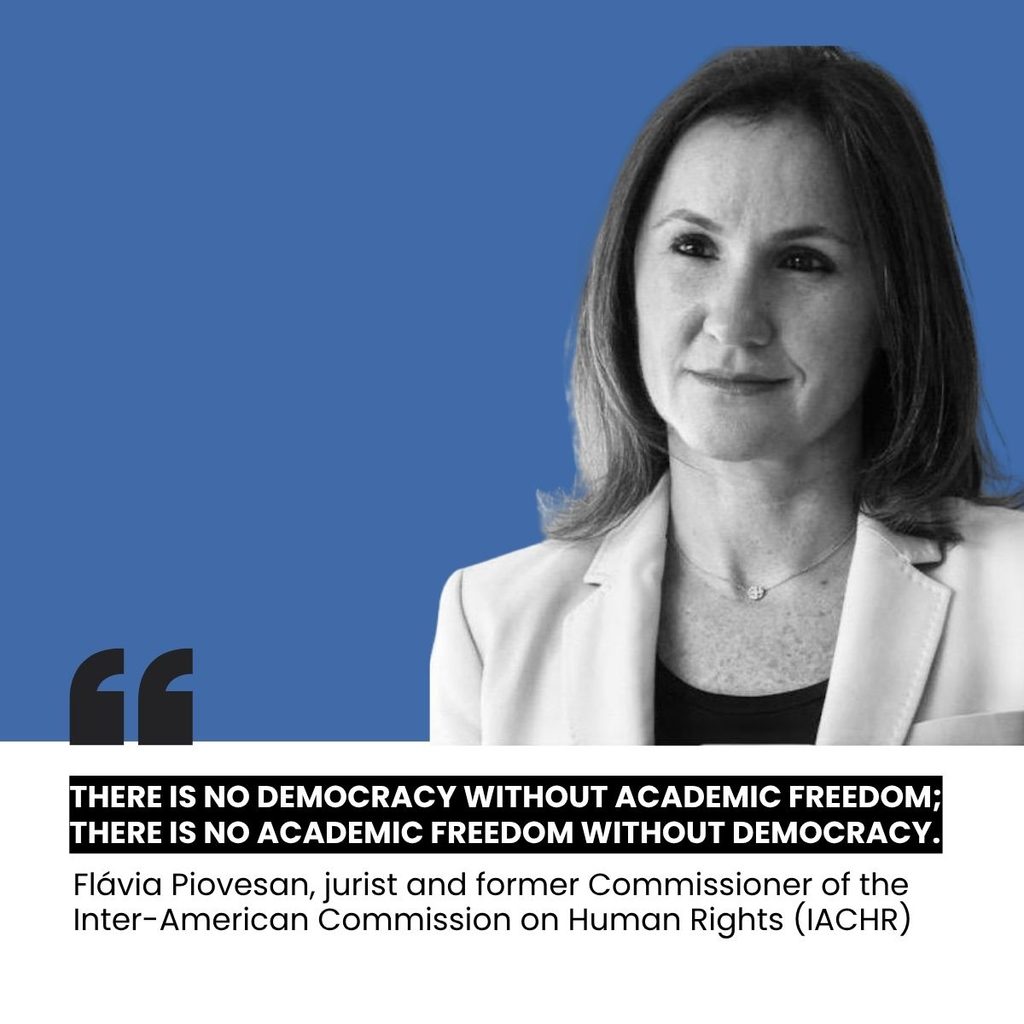
Jurist and former Commissioner of the Inter-American Commission on Human Rights (IACHR) Flávia Piovesan participated in the development of the Inter-American Principles on Academic Freedom and University Autonomy. In this interview, conducted as part of CAFA’s “Academic Freedom NOW!” campaign, she reflects on the process that led to their adoption in 2021 and warns that, five years later, the central challenge is to turn this rights framework into an effective tool in the face of attacks on science, universities, and democratic pluralism.

From a fragmented fiagnosis to an Inter-American Standard
Academic freedom did not emerge on the Inter-American agenda in the abstract. For Flávia Piovesan, its recognition was the result of a process driven by complaints, mobilization by organizations, universities, and academic communities that were documenting a growing pattern of threats across the Americas.
During her term as a Commissioner of the Inter-American Commission on Human Rights (IACHR), from 2018 to 2021, Piovesan began to identify an increasing number of complaints related to attacks on academic freedom. These situations included repression of student groups, harassment, budget cuts, retaliation, and arbitrary or discriminatory measures against faculty and students.
A regional hearing held in Bolivia was, for her, a decisive moment. The participation of universities and organizations such as Scholars at Risk made it possible to bring together situations that had previously appeared as isolated and dispersed cases.
“This hearing […] gave us a snapshot of the serious threats and hostility that the academic community was experiencing in the region.”
The diagnosis also revealed a normative gap. Faced with the question of which provision of the American Convention explicitly recognized academic freedom, Piovesan identified a gap that needed to be addressed.
This marked the beginning of an open, collective, and participatory process to develop the Inter-American Principles on Academic Freedom and University Autonomy, adopted by the IACHR in 2021.
For Piovesan, the participation of universities was essential. The process also sought to strengthen dialogue between academia and the Inter-American human rights system. It involved hearings, seminars, consultations, comparative studies, and successive versions of the document.
“The process is as valuable as the outcome.”
The development of the Principles did not follow a closed process. It brought together universities, organizations, experts, and States. The aim, Piovesan emphasizes, was to develop the standards from the ground up through a “participatory, open, transparent, and inclusive” process.
An individual, institutional, and collective Human Right
One of the central contributions of the Principles is their recognition of academic freedom as an autonomous and interdependent human right.
This definition breaks with a restricted understanding of academic freedom as a prerogative belonging exclusively to universities or those who work within them. For Piovesan, it is a right connected to freedom of expression, the right to education, freedom of conscience and association, the right to science, and other fundamental rights.
The individual dimension protects the ability to generate, seek, and transmit knowledge. The institutional dimension requires university autonomy. The collective dimension recognizes that society as a whole also has the right to benefit from scientific and academic production.
“Just as the Court said that freedom of expression is the cornerstone of democracies, I make the same argument, by analogy, regarding academic freedom,” she says.
And she offers a synthesis that runs throughout the interview:
“There is no democracy without academic freedom; there is no academic freedom without democracy.”
University autonomy occupies a central place in this architecture. It is not limited to administrative matters. It encompasses financial, budgetary, pedagogical, organizational, and scientific decisions, as well as the inviolability of academic spaces and the conditions necessary for academic communities to carry out their activities without arbitrary interference.
The Principles also establish obligations for States. Refraining from arbitrary interference, censorship, and the improper use of criminal law are among the negative obligations. Creating the conditions for a pluralistic, inclusive, and nondiscriminatory environment is part of States’ positive obligations.
Academic freedom in the face of rising authoritarianism
Five years after the adoption of the Principles, Piovesan considers that the context that prompted their creation has not lost its relevance. On the contrary, it has taken on new dimensions.
The interview highlights a context of increasing autocratization and attacks on pluralism. Authoritarian regimes, she argues, tend to silence dissent and restrict the circulation of ideas that challenge a single way of thinking.
In this context, academic freedom is directly connected to the defense of science.
Piovesan draws attention to scientific denialism and attacks against researchers working on issues such as the climate emergency and public health. For her, protecting freedom of research also means protecting society’s ability to produce knowledge and address collective challenges.
“Academic freedom, without freedom of research, without the transformative power of ideas, does not allow science to exist.”
Her reflection is also connected to the recognition of the right to science. Scientific production is not merely an activity internal to universities. It is related to the right of society as a whole to enjoy the benefits of science and scientific progress.
It is at this point that academic freedom, science, and democracy converge.
The Principles as a tool for action
For Piovesan, the 16 Principles should not remain merely a legal framework of reference. They should be embraced by those working to defend democracy, science, and human rights.
She describes them as a kind of toolbox: a resource for strengthening actions, practices, and legal and political advocacy.
“Today, we have a powerful instrument.”
The task now is to disseminate the Principles, expand awareness of them across different geographies, and use them in concrete situations involving violations of academic freedom and university autonomy.
This means translating the Principles into public policies, institutional commitments, and protection mechanisms. It also means monitoring attacks, responding to serious situations, and, when necessary, turning to the mechanisms of the Inter-American system.
For Piovesan, this process can have a catalytic effect: strengthening actors, mobilizing agendas, and expanding the capacity for democratic resistance.
The creation of the Principles, therefore, did not close an agenda. It opened a new one.
“Every point of arrival is a point of departure.”
It is precisely this transition—from recognition to implementation—that frames the “For Democracy. For Knowledge as a Public Good. Right to Academic Freedom NOW!” campaign of the Coalition for Academic Freedom in the Americas (CAFA).
The campaign is grounded in a premise: academic freedom is a human right and a democratic principle. It protects those who teach, learn, and conduct research. It protects institutional autonomy. And it protects society, which has a right to the knowledge produced through academic and scientific activity.
The dispute, therefore, is not only about universities. It concerns the democratic conditions needed to produce, question, share, and access knowledge.
As Piovesan puts it, the Principles must be collectively embraced as a tool capable of strengthening academic freedom, university autonomy, science, pluralism, and democracy.