For democracy. For knowledge as a public good.
Academic freedom is a human right. Its implementation is a democratic responsibility.
Academic freedom protects the freedom to teach, learn, research, create, question, debate and share knowledge without fear of censorship, intimidation, discrimination or undue interference.
It is an individual, institutional and collective right.
It protects educators, researchers and students. It protects the autonomy of academic institutions. And it protects the right of society as a whole to access and benefit from knowledge produced within them.
Academic freedom can only flourish with scientific rigor, human rights and democracy.
Why talk about academic freedom now?
Democracies are facing growing pressures, while universities, academic communities and scientific knowledge are increasingly exposed to different forms of interference and attack.
Censorship, violence, persecution, discrimination, criminalization, disinformation, attacks on science, restrictions on university autonomy, and political and economic pressures threaten the conditions necessary to produce and share knowledge.
When academic freedom is attacked, society as a whole loses.
It loses the capacity to question, understand reality, confront injustice, develop solutions and make democratic decisions based on knowledge.
Defending academic freedom is defending democracy.
Defending academic freedom is defending the right to know.

1. INDIVIDUAL
Academic freedom protects educators, researchers, students and other members of academic communities. The right to: teach, learn, research, create, question, debate, publish and share.
2. INSTITUTIONAL
Academic freedom depends on the autonomy of academic institutions. This includes: pedagogical, administrative, financial and physical autonomy. So that universities and research institutions can fulfill their functions with independence and pluralism.
3. COLLECTIVE
Academic freedom also belongs to society. Everyone has the right to benefit from knowledge, research, innovation and scientific progress.
Knowledge is a public good. But knowledge as a public good does not mean knowledge without standards: its production must be grounded in scientific rigor, integrity, human rights and democratic principles.

In 2021, the Inter-American Commission on Human Rights adopted the Inter-American Principles on Academic Freedom and University Autonomy, recognizing academic freedom as a human right within the Inter-American system.
The challenge now is implementation.
01 — Scope of protection of academic freedom
02 — Autonomy of academic institutions
03 — Non-discrimination
04 — Protection against State interference
05 — Protection against acts of violence
06 — Inviolability of academic spaces
07 — Restrictions and limitations on academic freedom
08 — Prohibition of censorship and the exceptional nature of punitive State action
09 — Protection and prevention against actions or omissions by private actors
10 — Human rights education
11 — Access to information
12 — Internet and other technologies
13 — Duty of the State as primary guarantor, plural participation and freedom of association
14 — Protection of international mobility and cooperation
15 — Inclusive dialogue within higher education
16 — Duty of implementation


The campaign “For democracy. For knowledge as a public good. Right to Academic Freedom NOW!” seeks to strengthen an understanding of academic freedom as a human right and democratic principle, while contributing to transforming this recognition into concrete action.
Through the campaign, we will explore different dimensions of this right:
WHAT IS ACADEMIC FREEDOM?
Its individual, institutional and collective dimensions.
WHY DOES IT MATTER?
Its relationship with democracy, human rights, science and knowledge as a public good.
WHO DOES IT PROTECT?
The people who teach, research, study and produce knowledge, particularly those facing violence, discrimination and persecution.
WHAT IS AT STAKE?
University autonomy, scientific integrity, pluralism, access to information, non-discrimination and protection against censorship and undue interference.
HOW CAN IT BE IMPLEMENTED?
Through policies, commitments, protection mechanisms, cooperation, monitoring and institutional action.

From August onward, CAFA will share interviews, articles, carousels, videos, testimonies and other materials to broaden the public debate on academic freedom and promote the implementation of the Inter-American Principles across the Americas.
AUGUST | For democracy. For knowledge as a public good.
Right to Academic Freedom NOW!
CAFA launches a regional campaign to reaffirm academic freedom as a human right and a democratic principle, in response to growing threats against academic communities, educational institutions and knowledge production.
The campaign starts from one conviction:
Academic freedom can only flourish with scientific rigor, human rights and democracy.
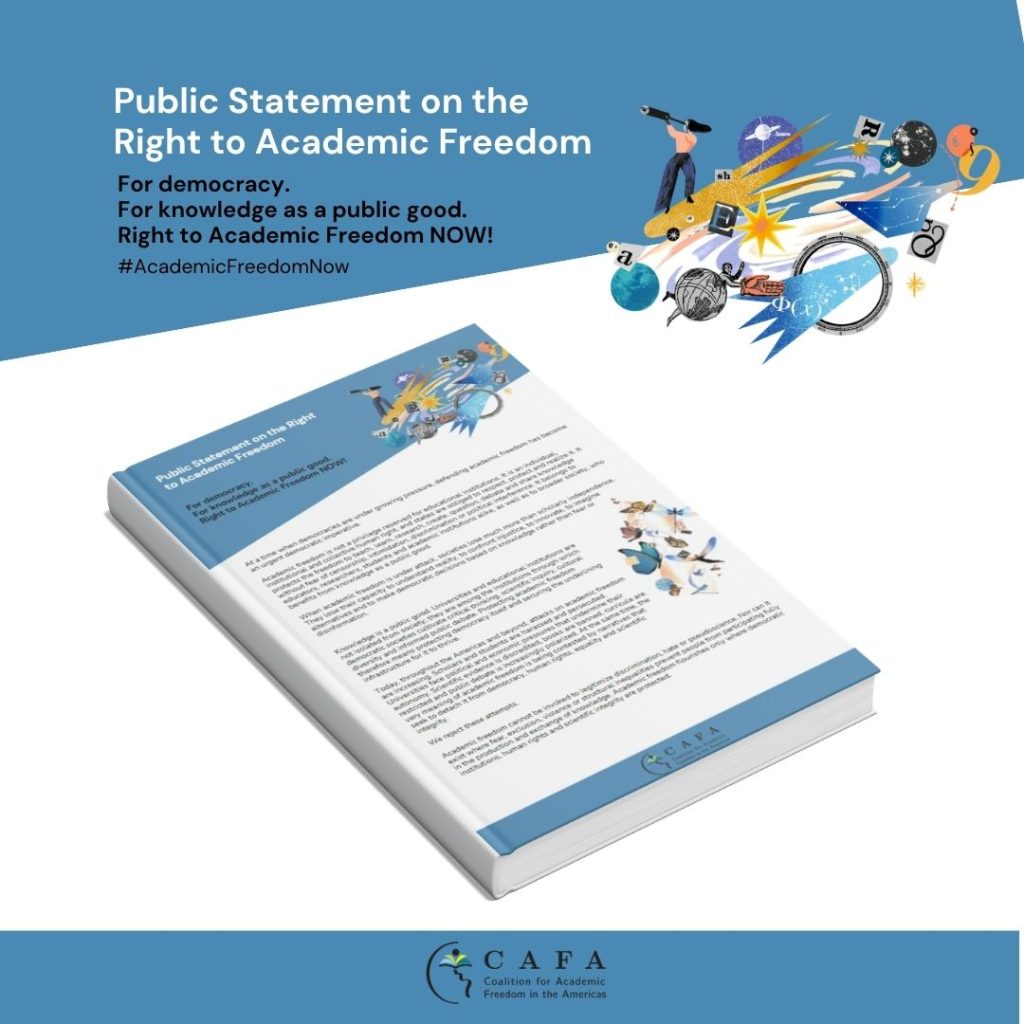
PUBLIC STATEMENT ON THE RIGHT TO ACADEMIC FREEDOM
For democracy.
For knowledge as a public good.
Right to Academic Freedom NOW!
CAFA’s statement calls on governments, academic institutions, scientific organizations, civil society organizations, the media and all those committed to democracy to recognize, protect and implement the right to academic freedom.