The coalition highlighted academic freedom as a key pillar for strengthening democracy in the region
The Coalition for Academic Freedom in the Americas (CAFA) participated in an international meeting held in Ávila (Spain), convened by the Organization of Ibero-American States for Education, Science and Culture (OEI), which culminated in the public presentation of the “Roadmap for Democratic Coexistence and Human Rights Education in Ibero-America” on April 29 at Casa de América in Madrid.
The initiative, led by the OEI, is the result of a collective process involving 25 international experts from academia, international organizations, civil society, and public administrations, who now form the “Ávila Group.” The Roadmap sets out strategic guidelines to strengthen human rights systems in the region and promote a democratic culture grounded in education, peace, and critical citizenship.
The presentation took place within the framework of an international dialogue on human rights education, democracy, and equality, in a global context marked by increasing polarization, the weakening of multilateralism, and the proliferation of narratives that challenge fundamental democratic values.
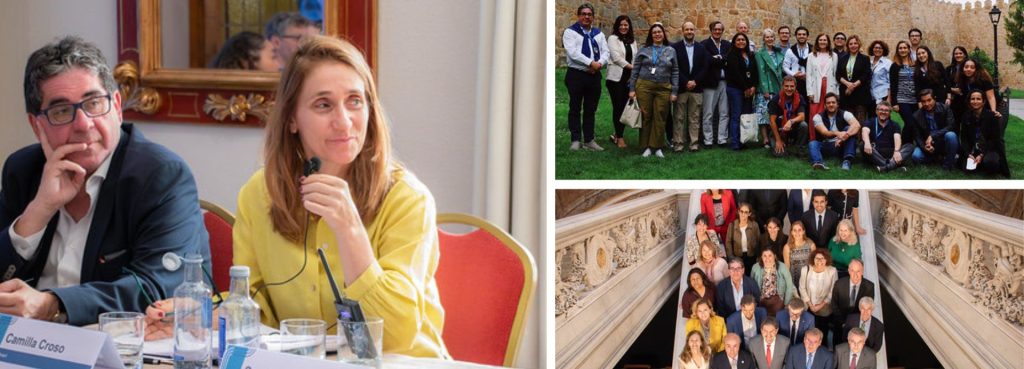
Camilla Croso, in yellow, during the event (left photo). Participants of the meeting (right photos).
CAFA’s contribution: academic freedom as a fundamental pillar of democracy
Camilla Croso, Executive Director of CAFA, participated in the meeting representing the coalition and emphasized the importance of the process as a milestone in Ibero-American cooperation: “The meeting promoted by the OEI on democratic coexistence and human rights education was a historic milestone. Bringing together 25 experts under the umbrella of an organization that connects countries from Europe and Latin America made it possible to analyze in depth the current crisis of multilateralism, the growing attacks on democracies worldwide, and to define concrete strategies for cooperation.”
Camilla Croso underscored that, in this context, the development of the Roadmap represents a key effort to address complex challenges through an articulated and multidimensional approach: “Based on this analysis of the international context and the attacks on democracies, what we did was to outline a roadmap to confront highly complex challenges, placing education at the center.”
From CAFA’s perspective, the process also helped highlight the fundamental role of academic freedom: “we underscored how academic freedom is one of the pillars for strengthening democracies and, at the same time, one of the fields currently facing the greatest attacks.”
Camilla Croso also noted that critical issues such as disinformation and the impact of the digital environment on democratic systems were widely discussed: “there was extensive discussion on the challenges posed by disinformation, particularly in relation to social media and digital platforms. We also emphasized how this crisis of truth affects the field of knowledge production.”
A strategic agenda for the region
The Roadmap proposes advancing key areas such as strengthening human rights education, addressing the impact of digital platforms on democracy, fostering cross-sector partnerships, and developing advocacy and strategic litigation strategies.
For CAFA, this process represents a key opportunity to consolidate the defense of academic freedom as an essential component of democracy in Ibero-America and to strengthen regional cooperation in the face of current challenges.