
CAFA invites you to a webinar launching its new study: “Scientific and Climate Denial as Threats to Academic Freedom in the Americas”
This report examines the rise of climate denialism and disinformation in the Americas, focusing on its political dimensions, origins, manifestations, and impact on the social and political landscape. It explores the relationship between these phenomena and broader scientific disinformation, their connection to the rise of authoritarian leaders and movements, and how these elements threaten academic freedom.
The study uses a qualitative exploratory approach, including:
- A systematic literature review
- Dialogues with fourteen specialists from academia and international organizations
- Comparative case studies on Brazil, the United States, and other Latin American countries
It presents a typology of climate denialism and disinformation to understand the different ways climate science is attacked or dismissed. The report also identifies key actors involved in spreading disinformation and proposes strategies to counter these challenges through public policy, civil society initiatives, science communication, and education, with examples from Brazil, the United States, Colombia, Chile, Mexico, and Argentina.
The study emphasizes that scientific denialism directly threatens academic freedom — the right to produce, share, and defend knowledge without interference. Attacks on scientists, including harassment and threats, are increasingly common, and academic freedom is under pressure in many countries.
Additionally, the report highlights the importance of COP30 as a platform to discuss information integrity, the right to science, and academic freedom, especially in light of the documented surge in climate disinformation leading up to the conference.
Reported Lauched
[English version]
Scientific and Climate Denialism and Disinformation as Threats to Academic Freedom in the Americas
Portuguese version – Negacionismo científico e climático e desinformação como ameaças à liberdade acadêmica nas Américas
Spanish version – Negacionismo científico y climático y desinformación como amenazas a la libertad académica en las Américas
Speakers:
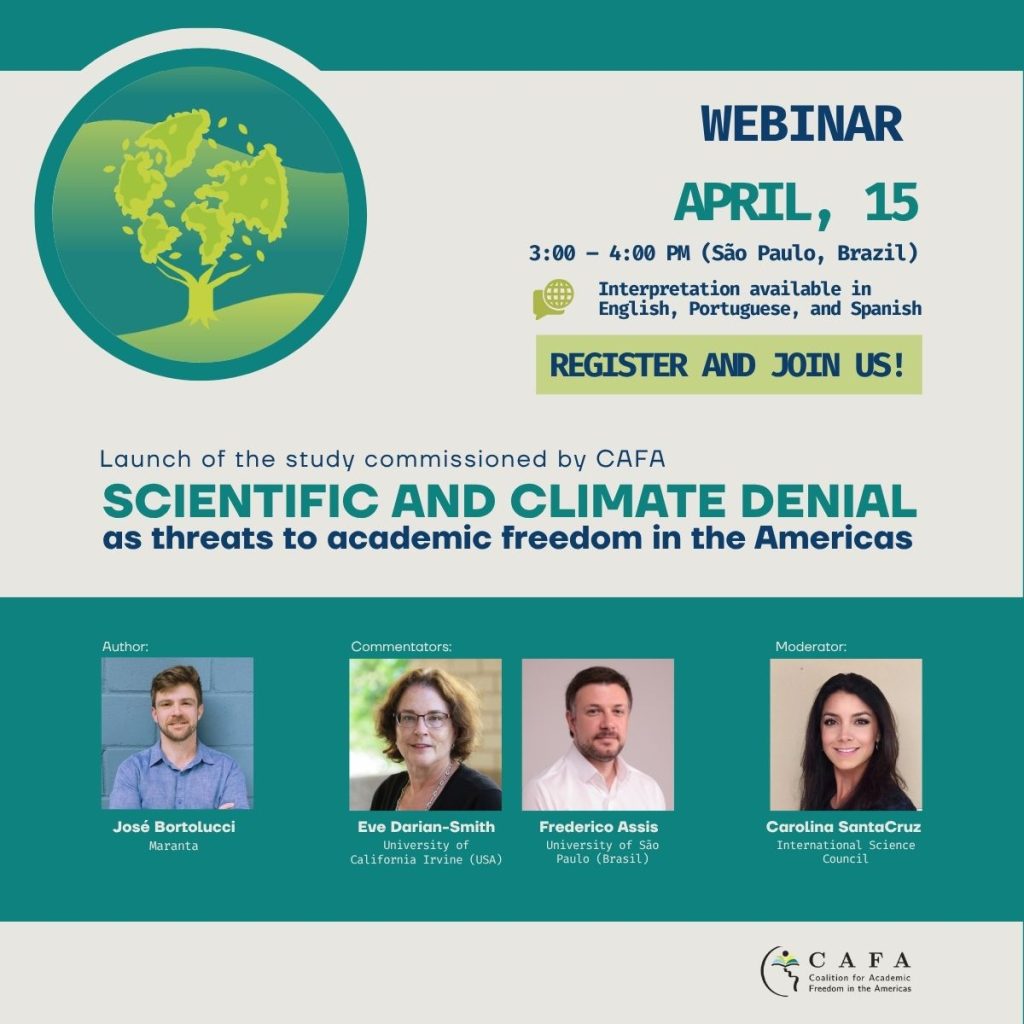
Author:
José Bortolucci (Maranta) – José Henrique Bortoluci holds a PhD in Sociology from the University of Michigan (CAPES/Fulbright fellow), a BA in International Relations (2007), and an MA in Social History (2009) from the University of São Paulo (FAPESP fellow), as well as an MA in Sociology from the University of Michigan. He has completed advanced training in Sociological Theory and Urban Studies at Yale University, the École des Hautes Études en Sciences Sociales (EHESS-Paris), and the Social Science Research Council (SSRC).
His research and teaching focus on Political Sociology (social movements, contemporary democracy, comparative politics), climate justice and policy, and urban studies. He also works as a consultant and speaker on issues related to cities, social movements, democracy, and climate policy.
He is a co-founder of Maranta Inteligência Política, a “think-and-do tank” focused on democracy and climate justice. His recent book O que é meu is being published in more than ten countries between 2023 and 2024. He currently has a forthcoming book on politics and architecture (Alameda Press) and a chapter in an upcoming international volume developed in collaboration with Columbia University and the University of Michigan.
Commentators:
Eve Darian-Smith (University of California, Irvine) – Eve Darian-Smith is Professor and Chair of the Department of Global and International Studies at the University of California, Irvine. A legal scholar and cultural anthropologist, her interdisciplinary research addresses human rights, legal pluralism, (post)colonialism, and socio-legal theory. Before entering academia, she practiced corporate law in Melbourne and earned her PhD in Cultural Anthropology in the United States. She is co-editor of the Global and Insurgent Legalities series (Duke University Press) and serves on the editorial boards of several international journals.
She received the LSA Herbert Jacob Book Prize for Bridging Divides: The Channel Tunnel and English Legal Identity in the New Europe and the Kevin Boyle Prize for Laws and Societies in Global Contexts. An active member of the Law and Society Association (LSA) since 1991, she has held various leadership roles, promoting diversity and strengthening the participation of international scholars and underrepresented groups in the global academic community.
Frederico Assis (University of São Paulo) – Frederico Assis is the Special Envoy for Information Integrity for COP30, working to address disinformation and climate denialism, with extensive engagement with political leaders, digital platforms, media organizations, and the Brazilian and international press.
Between 2023 and 2025, he served as Special Advisor to the Presidency of the Republic. He also served as Chair of the Board of Empresa Brasil de Comunicação (EBC).
He worked on Luiz Inácio Lula da Silva’s campaign, handling institutional relations focused on combating disinformation.
He was a consultant at Curado & Associados, one of Brazil’s leading firms in image and crisis management.
He was a co-founder of Maranta Inteligência Política, a think-and-do tank focused on sustainability issues.
He served as Political Advisor to Fernando Haddad between 2017 and 2021, including as a direct advisor during the 2018 presidential campaign.
He was General Coordinator of the International and Federative Relations Secretariat of the São Paulo City Hall and Special Advisor to the Mayor of São Paulo between 2013 and 2016.
He worked as a professor at the Escola Superior de Administração, Marketing e Comunicação between 2010 and 2012.
He holds a Bachelor’s degree in International Relations from the University of São Paulo (USP) and a Master’s degree in Social History from the same university.
👩💼 Moderator:
Carolina Santacruz-Pérez is a scientist and entrepreneur with a strong track record in the life sciences and bioeconomy. Since 2002, she has led international scientific projects and currently serves as Senior Science Officer at the International Science Council, where she acts as the Regional Focal Point for Latin America and the Caribbean.
She is also actively engaged in initiatives that promote women’s leadership in science.