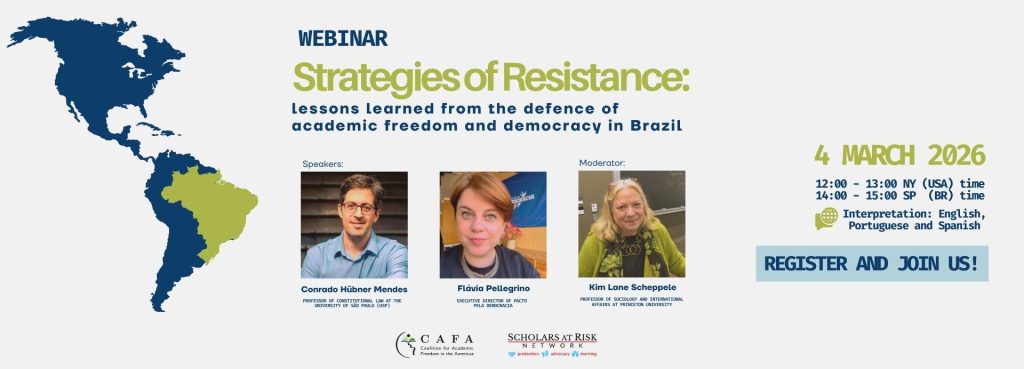
Between 2019 and 2022, Brazil’s academic community faced systemic attacks on university autonomy and scholars’ safety. This webinar brings together leading experts to share transferable strategies and practical solutions for resisting democratic erosion, both in Brazil and beyond.
Speakers:
Conrado Hübner Mendes is a Professor of Constitutional Law at the University of São Paulo (USP). He holds a PhD in Law and a PhD in Political Science and is a member of both the SBPC’s Observatory for Research, Science and Freedom and CAFA. A regular columnist for Folha de São Paulo, he played a central role in publicly denouncing democratic backsliding and threats to academic freedom during the Bolsonaro administration. In 2021, he became the target of legal harassment by the Prosecutor General of the Republic, who initiated proceedings against him in retaliation for critical articles published in his Folha column.
Flávia Pellegrino is the Executive Director of Pacto pela Democracia, a leading Brazilian civil-society coalition dedicated to defending democratic institutions, civic space, and human rights. Internationally, Flávia has played an active role in strengthening transnational cooperation against democratic erosion, participating in initiatives such as the Fisher Family Summer Fellows on Democracy and Development at Stanford University and the Keseb Democracy Fellowship. She holds a degree in Journalism from PUC–São Paulo and a Master’s in Political Science from IHEAL – Sorbonne Nouvelle.
Moderator:
Kim Lane Scheppele is the Laurance S. Rockefeller Professor of Sociology and International Affairs in the Princeton School of Public and International Affairs and the University Center for Human Values at Princeton University. Her primary field is the sociology of law and she specializes in ethnographic and archival research on courts and public institutions. She also works in sociological theory, comparative/historical sociology, political sociology, sociology of knowledge and human rights. Professor Scheppele’s research examines the rise and fall of constitutional government. She has studied the way that democracies have come under stress, focusing on the rise of new autocrats, particularly those who are elected on populist political platforms and who then use the law to undermine constitutional institutions. Now, she concentrates in particular on changes within the European Union – exploring the way that the EU has had difficulty holding its own against national popular movements that brought about Brexit and the rise of illiberal autocracies among the member states.